-
Lina - Astropsyche World
-
January 22, 2026
-
Astrology Insight
Leo’s shadow has little to do with “pride.” Pride is just a cultural layer over what is, at its core, a raw, nervous hunger: the hunger for confirmation that it exists. Not a need for love, but for proof. Not for closeness, but for a signal that it is “someone.”
The irony is that it appears confident on the outside. And it is—but that confidence is often just a well-pressed compensation. In Jungian terms: the persona is oversized, too tightly fused to identity. And when it cracks, what waits underneath is not the gentle vulnerability of self-help stories, but shame. The kind of shame that can’t be spoken, so it gets turned into attitude, arrogance, contempt, or control.
In that shadow, Leo doesn’t seek understanding—it seeks recognition. But “recognition” has no measure. It isn’t “I see you,” but “I exalt you.” And if that isn’t done well enough, a small, dirty arithmetic of punishment begins.
The shadow works simply:
If it is seen—it is calm.
If it is not seen—it becomes dangerous.
There’s no need to insult it. It’s enough not to be impressed. Enough to respond lukewarmly. Enough to say “ok” instead of “wow.” Then the thing it despises most ignites: the feeling of being replaceable. And in its mind, replaceability is the same as disappearance.
That’s why Leo can often be rude in a sophisticated way: lowering someone “in passing,” through a joke, through “honesty,” through pseudo-care. As if measuring spine and posture—how much someone will bend so it can remain large. Of course it will call that a standard. Of course it will say it “doesn’t tolerate nonsense.” But in truth it often can’t tolerate anything that doesn’t feed its self-image—its Ego.
Projection is its pet. When something hurts inside, it doesn’t carry it on its back or in its chest—it throws it outward, projects it onto someone else. You’re jealous. You’re small. You’re the problem. You “don’t get it.” Translation: there will be no talk about its fear of insignificance; there will be talk about your flaws, because your flaws are safer than its abyss.
In this shadow there is also “generosity,” but with a quiet poison: it gives—and remembers, records. It gives—and expects it to become your religion. It expects loyalty even when it goes too far. Protection from consequences. Admiration even when it causes chaos. If not, you’re ungrateful. You “don’t know how to appreciate.”
And the truth is: Leo can be a magnet. It looks like strength. People stick to that energy until they realize that behind it there is often dependency—on attention, status, the feeling of superiority. That’s why this archetype, in the dark, can leave devastation—not because it is “evil,” but because it is frightened in the wrong places. Afraid to be small. Afraid to be ordinary. Afraid to be seen without a filter.
Intimacy: where Leo’s shadow shows its teeth
In love, Leo’s shadow starts strong: warm, present, intense. Not because it is acting—but because it feels powerful and safe then. The partner is a mirror that works. And while it works, everything is fine.
But as soon as the relationship becomes real—as soon as boundaries arrive, routine, “I can’t right now,” “I disagree”—Leo reacts as if someone is stealing its air. Then appear:
Because Leo’s shadow cannot tolerate a partner’s autonomy. It wants closeness, but closeness on its terms: the partner is there, but it remains above—emotionally untouchable, central, right.
Passion can be strong, real, even noble—but it often carries an additional function: to confirm value. Sex becomes a test of desirability, dominance, specialness. Not “I love you,” but “I need you to want me so I can return to myself.”
When insecure, Leo eroticizes control: possession, jealousy. Closeness as a reward, withdrawal as punishment. Not because it is consciously manipulating, but because it doesn’t know any other way to regulate inner chaos.
The most intimate moment is the most dangerous: when a partner approaches gently, as an equal, without idolization. Then Leo’s shadow loses its food. Then it must be only human. And that hurts.
It wants unconditional love, but behaves in a way that forces love to constantly sit an exam. It doesn’t seek presence—it seeks confirmation. It doesn’t seek a relationship—it seeks proof that it is still above doubt, above questions, above the “ordinary.”
It wants closeness, but closeness strips it bare. Because closeness brings details: routine, imperfection, boundaries, moments when there is no room for performance. And where there is no performance, what has long been held under control remains: an insecurity that doesn’t know how to ask gently, so it asks roughly.
It wants to be seen, but cannot tolerate a real gaze. It cannot tolerate being noticed without exaggeration, without ceremony, without a sigh. A real gaze doesn’t applaud—it registers. And registration isn’t enough for someone who secretly fears that “enough” is just another word for “replaceable.”
And that is the closed loop: it wants tenderness, but doesn’t know how to carry it. It wants peace, but cannot endure it. When there is no drama, it begins to manufacture it—just so it can be felt again that something “burns,” that something “matters,” that something confirms existence.
If this stings—it should sting. Not to accuse, but to recognize: where life is not lived from the heart, but from the need to be constantly validated. Where love isn’t received, but audited. Where closeness isn’t built, but controlled.
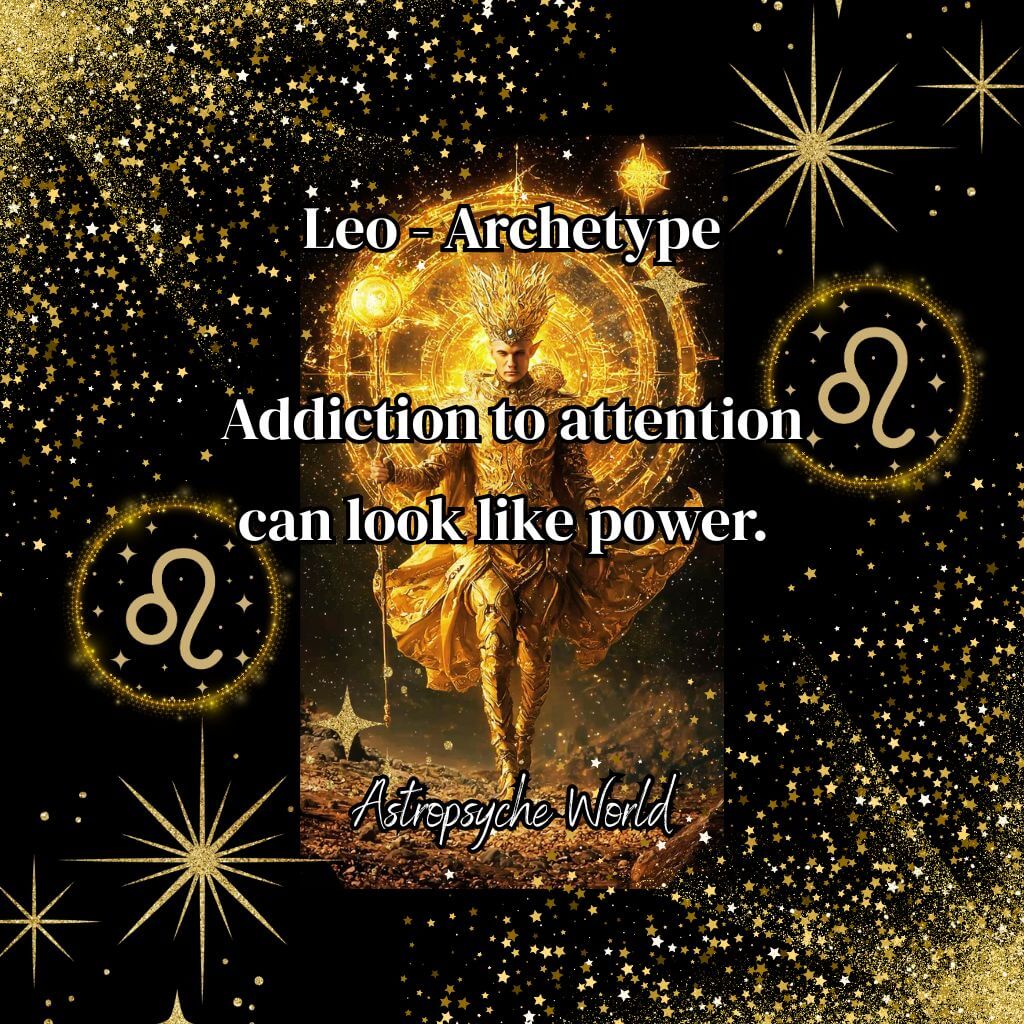
In Jungian logic, Leo is most easily read through the archetype of the King and his close kin: the Hero and the Child. This isn’t a “horoscope label,” but a symbolic pattern—the way the psyche organizes the need for identity, recognition, and meaning. In its healthy form, the King brings warmth, uprightness, protection, creativity, nobility. It is a figure that can be central without violence, visible without pressure, a leader without humiliation.
The problem begins when the archetype takes the wheel and the ego swells to the point of inflation.
Inflation is Jung’s term for the moment when the ego starts behaving as if it were the archetype itself: as if it were “born” for the throne, as if attention belongs to it, as if it’s natural that others keep time with its inner unrest. Then the King stops being a symbol of inner maturity and becomes a demand others must serve.
In that state, the persona usually looks immaculate: dignity, confidence, “standards.” But in the background another figure is working—what Jung called the wounded child in archetypal clothing. That’s where the darkness is explained: on the outside stands the “ruler,” while on the inside sits the fear of being skipped over, forgotten, outshone, pushed aside.
That is why, in the shadowed form of the archetype, the following dynamics appear:
Jung would say: when the shadow isn’t recognized, it gets projected. Everything that disturbs inside—neediness, envy, shame, a sense of smallness—comes out as accusation. In that way the archetype protects its self-image: it won’t allow what lies beneath the image to be seen.
And individuation (the Jungian path of maturation) here looks brutally simple, yet psychologically costly: stepping down from the inner stage, stopping the constant proving, and tolerating ordinariness without panic. Not becoming smaller—but becoming more real. Because a healthy King doesn’t depend on applause: it exists even when there is silence.
Written by Lina Astropsyche World