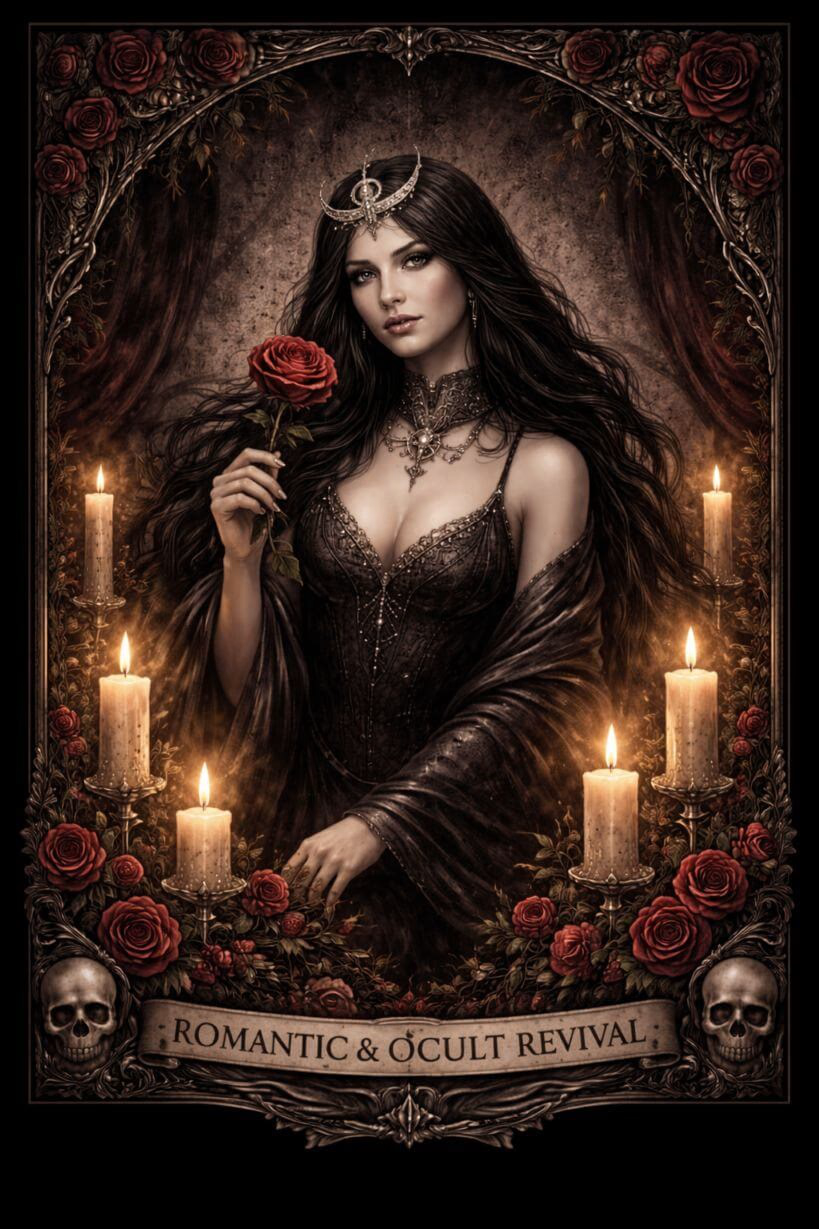
Romantic and Occult Revival: Lilith Reimagined
From the late eighteenth century through the early twentieth, Lilith re-enters Western culture transformed. The medieval demon of fear becomes a figure of fascination, reshaped by Romanticism, Symbolism, and occult revival movements.
This Lilith is neither biblical nor folkloric in any strict sense. She is literary, artistic, and symbolic—born from imagination rather than doctrine.
Romanticism and the Return of the Forbidden Feminine
Romantic writers and artists were drawn to what religious and moral systems had suppressed: emotion over doctrine, instinct over law, imagination over authority. Lilith enters this cultural moment as a natural inhabitant of the forbidden.
She appears as seduction, reflection, and danger intertwined—the dark feminine mirror to rational order.
One of the most influential depictions appears in Faust (1808) by Johann Wolfgang von Goethe. Here, Lilith is named as Adam’s first wife, dangerous not for her violence but for her beauty, her hair said to ensnare men.
In this portrayal, Lilith is no longer merely a demon. She becomes allure itself—charged with erotic and psychological power rather than moral transgression.
Victorian Art and Symbolism
Nineteenth-century art, particularly among Symbolists and the Pre-Raphaelites, gives Lilith a visual body.
In Dante Gabriel Rossetti’s Lady Lilith, she appears absorbed in her own reflection, surrounded by mirrors, flowing hair, and lush floral imagery. Beauty is central, but so is autonomy. The image emphasizes self-possession, sensuality, and inward focus.
This Lilith does not threaten children, doctrine, or faith. She threatens control. What disturbs is not her malice, but her independence from moral certainty and male authority.
Occult and Esoteric Reinterpretation
At the same time, Western occult traditions absorb Lilith into symbolic cosmology. Kabbalistic reinterpretations, Hermetic systems, and early Theosophical writings reframe her as a necessary counterpart within creation.
Here, Lilith becomes a cosmic feminine principle—associated with night, the Moon, hidden knowledge, and the shadowed side of divine order. She is no longer purely evil. She represents what must be excluded for order to define itself, and therefore what remains essential, though unacknowledged.
Lilith shifts from moral enemy to metaphysical necessity.
Transition Toward Psychology
By the late nineteenth and early twentieth centuries, Lilith stands at a threshold. She is no longer only demon, seductress, or mythic antagonist. She has become a symbol—awaiting psychological language.
This is the Lilith that will soon be encountered, indirectly, by depth psychology and later by astrology: no longer expelled, but contemplated.
Jungian Perspective
(symbolic, not historical)
From a Jungian perspective, the Romantic and occult Lilith marks the beginning of a withdrawal of projection. What was once externalized as evil begins to be aestheticized, mythologized, and inwardly explored.
Lilith becomes an image through which the psyche approaches desire without permission, identity without obedience, and femininity beyond moral binaries.
She is no longer feared into silence. She is imagined.
Why This Phase Matters
This period accomplishes a crucial shift:
Lilith is reclaimed from fear into art and imagination
She transitions from moral threat to symbolic presence
The groundwork is laid for modern psychological and astrological interpretations
Without the Romantic and occult revival, modern Lilith would have no symbolic vocabulary in which to appear.
References
Literary & artistic sources
- Goethe, Johann Wolfgang von — Faust, Part I
- Rossetti, Dante Gabriel — Lady Lilith (painting & poem)
Scholarly works
- Patai, Raphael — The Hebrew Goddess
- Baring, Anne & Cashford, Jules — The Myth of the Goddess
- Encyclopaedia Britannica — entries on Romantic symbolism and mythic figures