-
Lina - Astropsyche World
-
June 20, 2026
-
Astrology Insight
The Vertex is not a planet.
It is not a celestial body.
It is not an energy you can see in the sky the way you can see Mars, Venus, or Saturn.
And precisely because of that, it is often misunderstood. People try to read it as just another “placement” in the birth chart, as if it described something that is constantly operating from within the personality.
But the Vertex does not work that way.
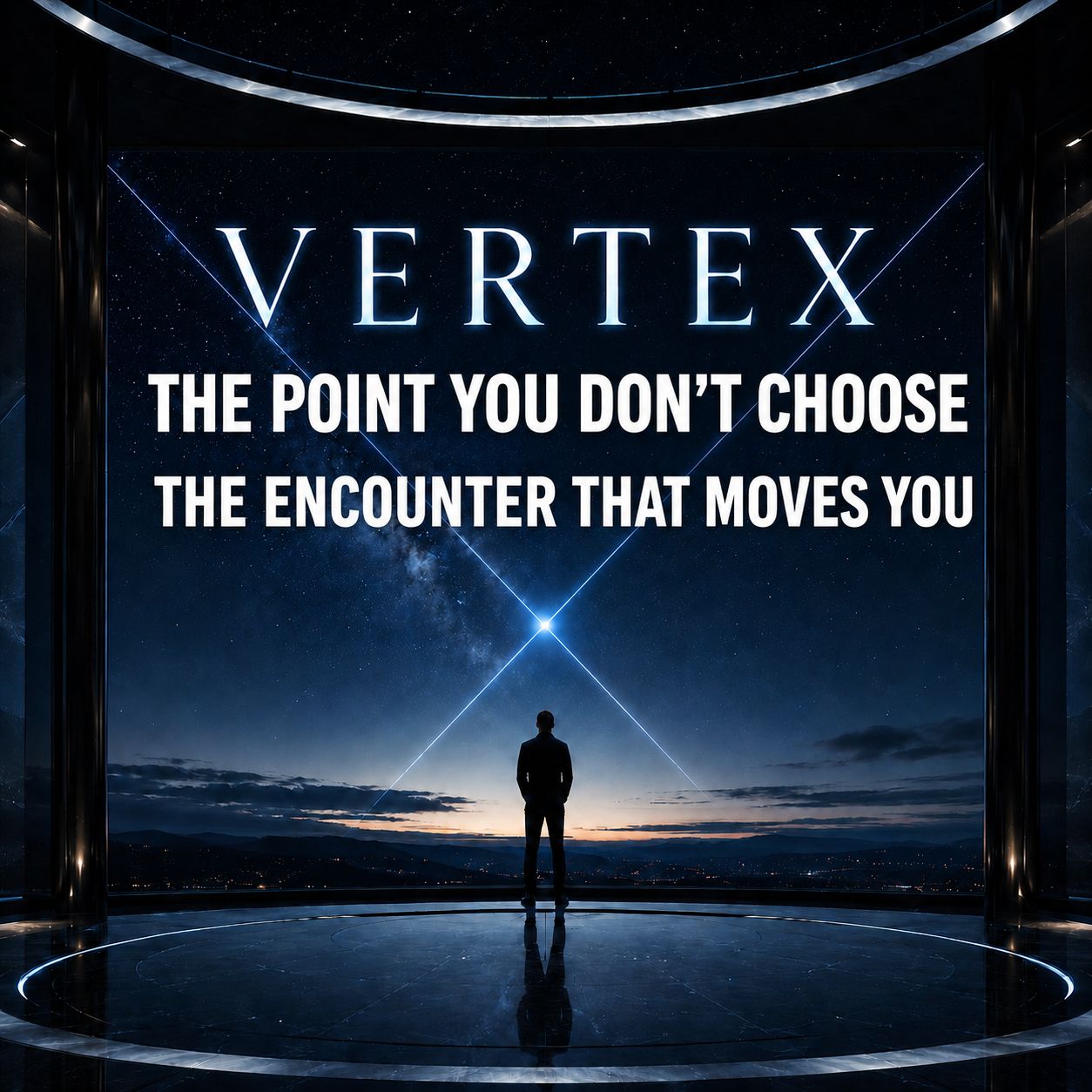
The Vertex is a sensitive mathematical point in astrology, often referred to as the “third angle” of the natal chart. Its symbolism is most commonly connected with encounters, events, and turning points that do not come from our conscious control, but appear as external triggers that move us out of the familiar course of life.
That is why the Vertex does not describe what a person actively chooses in the same way they choose through the Sun, Mars, or the Ascendant. More often, it points to the place where life comes toward us through other people, circumstances, relationships, and events that carry unusual weight.
Not because they are always romantic, beautiful, or “fated” in a superficial sense, but because they often leave the impression that we have been moved from one inner or life direction into another.
Technically, the Vertex is formed by the precise intersection of two lines: the ecliptic, the apparent path of the Sun, and the prime vertical, an imaginary great circle that passes through the eastern and western points of the horizon, the zenith, and the nadir.
So the Vertex is not an object in the sky, but a calculated point within the space of the natal chart.
In the birth chart, it is always found in the western hemisphere, most often in the fifth, sixth, seventh, or eighth house, although depending on the house system and geographic latitude, it can occasionally appear in the fourth or ninth house as well.
That fact alone already says a great deal: the Vertex belongs to the part of the chart that is not directed only toward the isolated will of the individual, but toward what comes through the world, through other people, through relationships, and through situations that in some way call us to respond.
For this reason, the Vertex is often activated in relationships that feel unexpectedly powerful. This does not automatically mean “great love,” nor does it mean a relationship that should be idealized.
Much more often, it means that a person or an event carries the function of a catalyst.
Something is set in motion.
Something becomes conscious.
Something can no longer remain the same.
When someone touches our Vertex with an important planet or angle in synastry, we may feel that the encounter does not belong to the ordinary order of things. But it is dangerous to immediately declare every Vertex connection “fated.”
Fated does not necessarily mean lasting.
Fated does not necessarily mean healthy.
Fated does not mean that a relationship must be preserved at any cost.
Sometimes “fated” simply means that the encounter had a task: to confront us with something we had not been able to see before.
The point directly opposite the Vertex is called the Anti-Vertex. If the Vertex shows what comes from the outside — through an event, another person, or a circumstance that moves us — the Anti-Vertex can be understood as the place of personal will, inner choice, and our own response.
This is where the most important distinction appears: not every event is under our control, but our response is never without meaning.
That is why the Vertex should not be read as a fatalistic verdict. It is not proof that one specific person, one relationship, or one scenario “has to” happen.
It more accurately shows the point where life breaks through our illusion of total control. The place where something from the outside touches us strongly enough that we can no longer remain the same.
The house in which the Vertex is placed shows the area of life through which these external triggers most often arrive: encounters, events, or experiences that move us out of a familiar pattern. This does not mean that “fate” will happen only through that house, but that through its symbolism, the space for a turning point, confrontation, or change of direction is most often opened.
When the Vertex is in the fifth house, turning points often come through love, falling in love, children, creativity, the need to be seen, recognized, and inwardly alive.
This is not only the house of romance. It is also the house of the heart’s risk. Encounters may awaken a part of the person that has long been asleep, suppressed, or trapped in the need to be rational, useful, or controlled.
When the Vertex is in the sixth house, external triggers often come through work, daily life, health, obligations, service, routine, and the relationship with the body.
Here, life turning points do not always appear dramatically. They may come through what repeats every day until it becomes clear that something has to change. The Vertex in the sixth house often shows that a turning point does not always have to look grand. Sometimes it begins through a job that drains us, a body that no longer stays silent, or a daily life that can no longer carry the old version of who we are.
When the Vertex is in the seventh house, it is most often activated through relationships, partnerships, marriage, public bonds, clients, and direct encounters with other people.
This is one of the positions that makes the Vertex so often associated with important relationships. But here, too, caution is necessary.
A person who activates the Vertex in the seventh house does not have to be someone we stay with forever. They may be a mirror, a turning point, an ally, an opponent, or someone who forces us to see more clearly what we seek in relationships — and what we can no longer accept.
When the Vertex is in the eighth house, turning points come through intense bonds, crises, intimacy, loss, shared resources, inheritance, power, trust, fears, and deep changes that cannot be resolved through superficial decisions.
This is a position where encounters often carry a strong inner charge. Someone does not touch us only emotionally; they open layers we may have preferred to keep closed. The Vertex in the eighth house often does not bring easy encounters, but it brings the kind that confront us with the question of how much closeness, truth, and change we can truly bear.
If the Vertex appears in the fourth house, the emphasis may fall on family, ancestry, home, private life, inner security, and themes of belonging.
Turning points may come through family events, relocation, changes in the home, or encounters that touch the deepest sense of roots. Here, an external event often activates the most private layers of the person: the question of where they belong, what they carry from the family system, and what they can truly build their inner security upon.
If the Vertex appears in the ninth house, external triggers may come through education, travel, foreigners, distant countries, beliefs, spiritual or philosophical systems, mentors, and experiences that expand one’s view of life.
Here, an encounter or event does not only change circumstances. It changes the way the person understands the meaning of what is happening to them. The Vertex in the ninth house often opens a door toward a larger life framework — not through theory, but through an experience that changes one’s perspective.
In serious interpretation, the Vertex gains meaning only through the sign, house, aspects, dispositor, and activations through transits, progressions, or synastry.
On its own, removed from context, it does not say enough. But when it is strongly connected with personal planets, angles, or important points in another person’s chart, it may indicate an encounter that carries the weight of a turning point.
Not because it frees us from responsibility.
But because it reminds us that there are moments when life does not come through a plan, but through an encounter.
Not through control, but through the interruption of a familiar pattern.
Not through what we chose in advance, but through what forces us to choose more consciously than before.
The Vertex is therefore the point where the question is not only:
“Who is entering my life?”
The real question is:
What changes within me when that person, or that event, enters my life?
Written by Lina Astropsyche Project